


Introduction: Santandereans and Dubliners — Cartographies of Paralysis and Violence in the Short Story
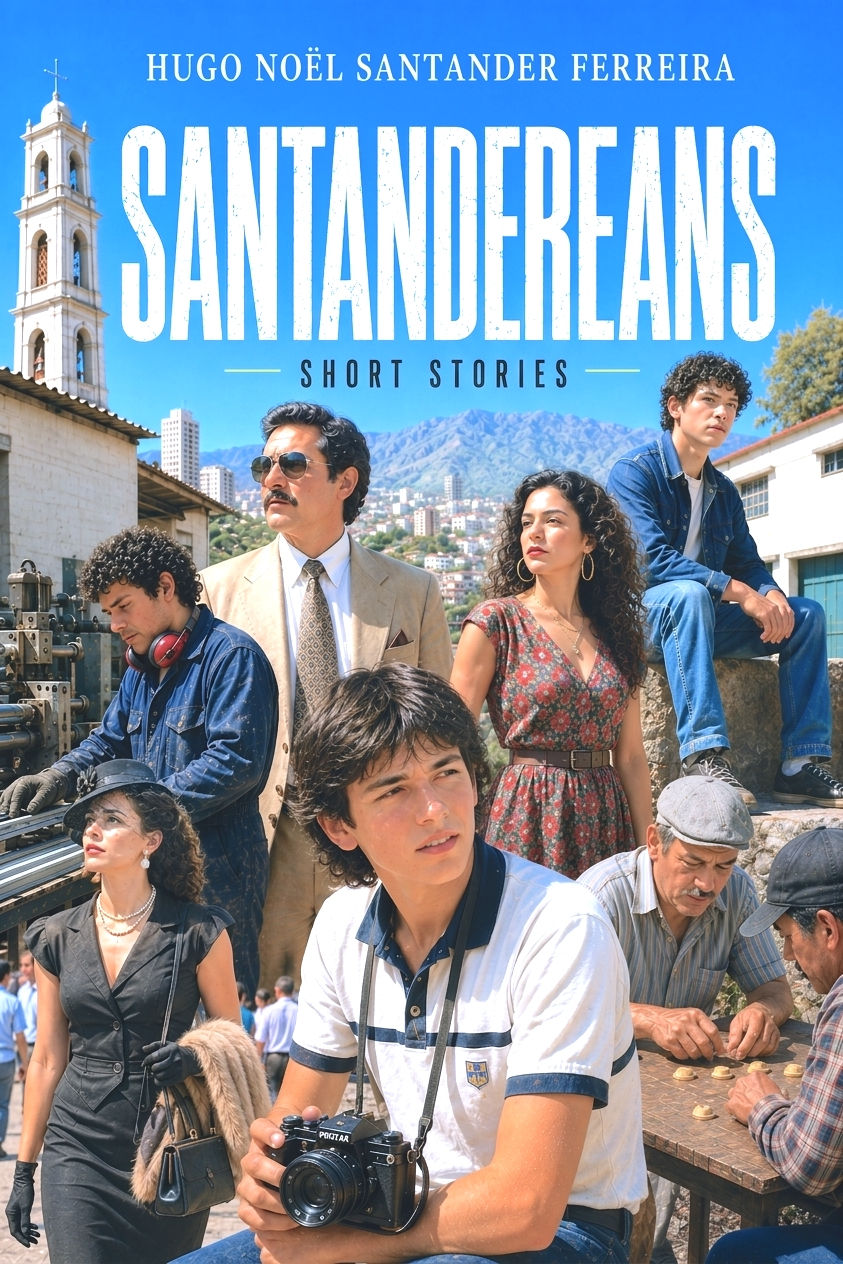
The tradition of the short story as an instrument of social dissection finds a significant renewal in Santandereans (2026) by Hugo Noël Santander Ferreira, a work that engages in explicit dialogue with the modernist canon, particularly James Joyce's Dubliners (1914). The volume's epigraph from T.S. Eliot — which anticipates ethical condemnation as a narrative horizon — establishes a literary program that transcends mere regional costumbrismo to inscribe itself in a tradition of cultural critique that Joyce inaugurated by representing Dublin as the "center of paralysis" of Ireland. Even the title of the Colombian collection, with its demonym, echoes the Joycean gesture of naming a people through their place.
Both works share a fundamental premise: the representation of a moral geography through stories that function as "micro-societies" where power circulates in its most everyday and, therefore, most insidious forms. However, while Joyce explores the spiritual paralysis of the Irish middle class under British colonial rule and ecclesiastical tutelage, Santander Ferreira deploys a territory where physical and symbolic violence — inherited from the Colombian civil wars, drug trafficking, and institutional corruption — operates as the organizing principle of social life. In this difference lies the relevance of a comparative study: it is not a matter of imitation, but of a critical appropriation of the Joycean form to account for a distinct historical and cultural reality.
The Structure of the Story as a Device of Power
In Santandereans, dialogue acquires an explicitly instrumental dimension. In stories such as "The Judge," legal and everyday language intertwine to construct a "web of domination" where "no one dominates completely," while in "The Little Godfathership," academic discourse reveals its proximity to bribery. This instrumentalization of speech reflects a society where the word is not a vehicle for understanding but a weapon of negotiation, threat, or seduction. Characters do not speak to describe the world but to position themselves within it; every sentence is an act: an imposition, a defense, a humiliation, or a mask.
Joyce, for his part, operates through what might be called a rhetoric of ellipsis: silences, pauses, and the unsaid reveal the impotence of his characters to articulate their desire or their critique. In "Eveline," the protagonist cannot express her rejection of emigration; in "The Sisters," the child narrator intuits more than he understands about the death of Father Flynn. Joycean paralysis is, above all, an inability to name.
Santander Ferreira inverts this dynamic: his characters speak excessively, but that excess betrays them. In "An Interview," Justin Ruhe deploys a Nazi and sadomasochistic discourse that is simultaneously a declaration of intentions and a ritual of domination; in "Whacks," the language of adolescents is a code of loyalty and betrayal that culminates in physical violence. Logorrhea replaces Joycean silence, but fulfills an analogous function: revealing the structure of a community that cannot escape its own rules.
Epiphany and Catharsis: Two Models of Revelation
The Joycean concept of epiphany — that moment of sudden revelation that illuminates the nature of reality — undergoes a radical transformation in Santandereans. While in Dubliners epiphanies usually lead to a realization that, however, does not translate into action (Gabriel Conroy in "The Dead" understands his own insignificance but cannot change his life), in Santander Ferreira's stories revelation is frequently a prelude to violence.
"The Eclipse" exemplifies this difference: the narrator, pursued by his enemies and finally arrested, experiences a visual revelation — the lunar eclipse — that allows him to momentarily escape his captor. But this epiphany does not lead to an existential transformation; it is, rather, a precarious truce in a world where persecution is the norm. Nature, in Joyce, often offers a beauty that contrasts with human misery (the final snow of "The Dead"); in Santander Ferreira, the landscape is complicit in violence or the scene of its consummation.
In "The Sprite's Leap," the protagonist's epiphany about his own complicity in homosexual exploitation — and his subsequent revenge — does not liberate him but plunges him into a spiral of crime and punishment. The revelation is not a moment of redemptive clarity but of destructive self-knowledge: the character understands his own hypocrisy and, instead of reforming himself, radicalizes it. This inversion of the Joycean epiphany reflects a profound cultural difference: the Colombian society represented by Santander Ferreira offers no exits from self-awareness; knowledge of oneself is, at best, a condemnation and, at worst, an incentive for cynicism.
The City and the Territory: Dublin vs. Santander as Collective Characters
The construction of space in both works deserves careful attention. Dublin, in Joyce, is a "center of paralysis" where streets, pubs, and houses function as symbolic prisons. The famous "snow falling faintly through the universe" at the end of "The Dead" universalizes the Irish experience, turning local paralysis into a metaphor for the human condition.
Santander, in Santander Ferreira's work, is a territory of permanent violence. It is not a matter of paralysis but of an incessant dynamic of conflict, where physical space — the Morrorico hill, the Chicamocha canyon, the Duende Falls — is always the scene of action that may be warlike, economic, or sexual. The city of Bucaramanga is not a place of stillness but of constant transit between different spaces of power: the social club, the school, the factory, the church, the brothel.
This difference can be read in terms of chronotope (Bakhtin): while the Joycean chronotope is that of the provincial city where time seems frozen, Santander Ferreira's is that of the frontier (Colombia as finis terrae) where historical time erupts with violence — the political Violence of the 1950s, the drug trafficking of the 1980s, the dirty war of the 1990s. In "Identity or Death," civil war is an event that defines the political identity of the characters; in "The Eclipse," the urban terrorism of Pablo Escobar forms the backdrop of everyday life. History is not suspended but active, even when characters try to ignore it.
Childhood and Education as Formation of the Subject
One of the most fertile parallels between both works is the treatment of childhood and education as devices for the formation of the subject. In Dubliners, the stories "The Sisters," "An Encounter," and "Araby" explore how Irish children are initiated into the structures of power — the Church, colonialism, patriarchy — that will determine their adult lives. The epiphany of "Araby," where the boy understands the futility of his romantic desire, is a moment of disillusionment that anticipates adult paralysis.
In Santandereans, childhood is a space of terror and learning of violence. "The Tower" shows adolescents testing their courage in an act of transgression that almost costs them their lives; "The Nothing" presents a boy who suffers family and school abuse until his only escape is suicide (or his dream of suicide). Education, far from being a space of emancipation, is a mechanism for reproducing social hierarchies: in "Electoral Contest," a school election becomes a lesson in political cynicism; in "The Comedian's Exclusion," the university is the scene of academic exclusions that reflect broader dynamics of power.
Joyce shows childhood as a time of fading illusions; Santander Ferreira, as a time of learning cruelty. In "Benito," the father fears his son may be homosexual and subjects him to a regime of discipline bordering on mistreatment; in "Whacks," adolescents learn that loyalty to the group requires violence against the other. The formation of the subject is not a process of humanization but of brutalization.
Satire and Humor as Strategies of Knowledge
Satire in Santander Ferreira has a sharper edge, closer to the tradition of Quevedo or of Latin American narrative's "grotesque realism." In "New Mayor," the scene of the mayor and his secretary soiling himself during the banquet is a satire of political corruption bordering on the grotesque; in "Cherché la femme," the love triangle between the employee, the accountant, and the secretary reveals the hypocrisy of class and gender relations in the workplace. Humor does not relieve tension but sharpens it, revealing the structure of a society where power is exercised even in the most absurd situations.
Joyce, by contrast, employs a more ironic and distanced humor, which seeks not laughter but a bitter smile. The ending of "The Dead," with its moving reflection on the snow falling "upon all the living and the dead," is profoundly serious; the satire resolves into elegy. Santander Ferreira, however, offers no elegiac consolation; his satire is relentless because his diagnosis leaves no room for redemption.
The Legacy of Dubliners and the Transformation of the Genre
The assertion that "the echo of James Joyce's Dubliners is no accident" is key to understanding Santander Ferreira's literary operation. It is not a servile imitation but a critical appropriation that updates the short story genre to account for a distinct historical and cultural reality. The author himself, as noted in the preface, "has spent much of his life away from his homeland, and from that distance he has built a gaze capable of revealing what proximity conceals."
This distance is both geographical (Santander Ferreira has lived much of his life outside Colombia) and temporal (the author writes from the twenty-first century about a recent past). Joyce also wrote Dubliners from exile — voluntary, in Trieste and Zurich — and that distance allowed him to see Dublin with a lucidity that residents perhaps could not achieve. Both authors share the perspective of the exile who observes his homeland with estrangement, but while Joyce contemplates the end of a colonial era, Santander Ferreira observes a nation trapped between the legacy of violence and the promise (always unfulfilled) of modernity.
The most significant transformation that Santander Ferreira operates on the Joycean model is the intensification of violence. Where Joyce suggests, Santander Ferreira shows; where Joyce elides, Santander Ferreira explicates. This is not an aesthetic defect but an ethical decision: violence in Colombia cannot be elided because it is constitutive of social experience. Joyce's "blank spaces" are replaced by "images of blood and corpses" that do not permit evasion.
Conclusion: Two Forms of Literary Modernity
Santandereans and Dubliners represent two moments of literary modernity in the short story. Joyce inaugurates a tradition of introspection that reveals the characters' inner life as the space where colonial and ecclesiastical power are internalized; Santander Ferreira, in contrast, prioritizes the exteriority of action — gesture, dialogue, the violent scene — as the place where power manifests in its most naked form.
This difference implies no hierarchy. Both authors share the purpose of dissecting their society through the short story, but their tools and their diagnoses are distinct because their objects of study are distinct. Dublin in 1914 is a city that slowly bleeds out, trapped in a past that refuses to pass; Santander in 2026 is a territory where the past constantly erupts into the present through political violence and judicial impunity.
The final gesture of both books is, however, similar: an invitation to the reader to recognize their own implication in the web of power that the stories describe. The snow falling "upon all the living and the dead" in Dubliners and the Eliot epigraph demanding that "you, and you, and you, must all be punished" in Santandereans point toward the same conclusion: that the community these stories represent is none other than our own, and that the only way out of its paralysis or its violence is knowledge — a knowledge that does not console but compromises.
In this sense, Santander Ferreira's debt to Joyce is not merely formal but ethical: both authors conceive literature as an instrument of social diagnosis that, without offering easy solutions, forces us to see what we would prefer to ignore. The difference lies in the object of that gaze: a Dublin slowly dying and a Santander surviving amid its own destruction.
This response is AI-generated, for reference only.
I disagree, Santandereans has plenty of suggested emotions and stories, just that expression is as it is in real life, there is no forceful deguise of expression
Introduction: Santandereans and Dubliners — Cartographies of Paralysis and Violence in the Short Story
The tradition of the short story as an instrument of social dissection finds a significant renewal in Santandereans (2026) by Hugo Noël Santander Ferreira, a work that engages in explicit dialogue with the modernist canon, particularly James Joyce's Dubliners (1914). The volume's epigraph from T.S. Eliot — which anticipates ethical condemnation as a narrative horizon — establishes a literary program that transcends mere regional costumbrismo to inscribe itself in a tradition of cultural critique that Joyce inaugurated by representing Dublin as the "center of paralysis" of Ireland. Even the title of the Colombian collection, with its demonym, echoes the Joycean gesture of naming a people through their place.
Both works share a fundamental premise: the representation of a moral geography through stories that function as "micro-societies" where power circulates in its most everyday and, therefore, most insidious forms. However, while Joyce explores the spiritual paralysis of the Irish middle class under British colonial rule and ecclesiastical tutelage, Santander Ferreira deploys a territory where physical and symbolic violence — inherited from the Colombian civil wars, drug trafficking, and institutional corruption — operates as the organizing principle of social life. In this difference lies the relevance of a comparative study: it is not a matter of imitation, but of a critical appropriation of the Joycean form to account for a distinct historical and cultural reality.
Expression, Suggestion, and the Realism of the Everyday
A crucial point of divergence between the two collections lies in their respective modes of expression. Dubliners operates through a carefully crafted literary style that, while realist in its depiction of Dublin life, is unmistakably the product of an author's aesthetic design. Joyce's prose is layered with symbolism, structural patterning, and linguistic refinement that distances the reader from the raw material of experience even as it evokes it. The famous opening of "The Dead" — "Lily, the caretaker's daughter, was literally run off her feet" — announces a voice that is both natural and artfully constructed.
Santandereans, by contrast, adopts a mode of expression that approximates the texture of lived speech and thought without the overlay of an authorial aestheticizing distance. The stories present their characters' experiences with a directness that mirrors the rhythms of real life: the language is colloquial, the syntax often unadorned, the emotional states suggested through action and dialogue rather than through elaborate interior monologue or symbolic patterning. This is not a failure of artistry but a deliberate choice to allow the material to speak for itself without interpretive mediation.
Yet this does not mean Santandereans lacks suggestion or subtlety. On the contrary, the collection is rich with implied meanings and unspoken emotions. "The Nothing," for instance, presents the story of Matías's abuse and eventual suicide through a spare, almost documentary narrative that refuses to moralize or interpret. The horror of his situation emerges not through authorial commentary but through the accumulation of details — the mother's red shoes kicking his small body, the grandfather's report of his escapes, the dream of the bridge without railings. The emotion is there, fully present, but it is conveyed through what the characters do and what happens to them, not through the author's rhetorical elaboration.
In "Whacks," the humiliation of Chino Pico and the gang's eventual violence against him are rendered with a factual precision that never descends into melodrama. The narrator's retrospective comment — "had we known that poor wretch's retinas would come loose, we would never have touched a hair on his head" — suggests regret without indulging in it. The emotion is understood to be present, but it is embedded in the narrative's fabric rather than extracted for the reader's consumption. This approach reflects how people in real life often process traumatic experiences: not with rhetorical flourish but with a flatness that itself becomes a form of emotional truth.
The Everyday as Moral Landscape
Where Dubliners tends to elevate its scenes through a symbolic apparatus that gives them universal resonance (the snow at the end of "The Dead," the bazaar in "Araby," the colonial imagery throughout), Santandereans remains resolutely rooted in the particularity of its setting. The stories do not reach for myth or archetype; they present Santander as a specific place with its own history of violence, its own social codes, its own ways of speaking and behaving. The political violence of "Identity or Death," the corruption of "The Judge," the class resentments of "Whacks" — these are not allegories for a general human condition but precise observations of a particular society at a particular historical moment.
This grounding in the everyday is not a limitation but a strength. The stories achieve their power precisely because they do not generalize; they show how violence and power operate in the specific circumstances of Santander — in the apartment in Cabecera, the aluminium door factory, the convent school, the social club, the working-class barrio. The reader is not invited to transcend these particulars but to understand them as the medium through which larger social forces are experienced.
The expression of emotion in this context follows the same principle. Characters in Santandereans do not articulate their feelings in polished prose or through elaborate symbolic gestures; they express themselves as people do in the circumstances Santander Ferreira describes. The father in "Benito" who beats his son out of fear that he might be homosexual does not explain his anxiety; he acts on it. The adolescent narrator of "The Tower" does not reflect at length on the meaning of his fall; he simply tells what happened. The gamblers of "The Shells" do not meditate on the morality of their schemes; they execute them.
This is realism of a particularly rigorous kind: not the realism that provides a carefully composed window onto life, but the realism that attempts to reproduce the texture of experience as it is lived, without imposing an interpretive framework that would make it more coherent or more pleasing than actual life is.
The Structure of the Story as a Device of Power
In Santandereans, dialogue acquires an explicitly instrumental dimension. In stories such as "The Judge," legal and everyday language intertwine to construct a web of domination where no one dominates completely, while in "The Little Godfathership," academic discourse reveals its proximity to bribery. This instrumentalization of speech reflects a society where the word is not a vehicle for understanding but a weapon of negotiation, threat, or seduction. Characters do not speak to describe the world but to position themselves within it; every sentence is an act: an imposition, a defense, a humiliation, or a mask.
Joyce, for his part, operates through a rhetoric that often relies on the unsaid: silences, pauses, and what remains unarticulated reveal the impotence of his characters to express their desire or their critique. In "Eveline," the protagonist cannot articulate her rejection of emigration; in "The Sisters," the child narrator intuits more than he understands about the death of Father Flynn. Joycean paralysis is, among other things, an inability to name.
Santander Ferreira's characters, by contrast, speak with the fluency of people who have learned to navigate a society where speech is a tool for survival. But this fluency does not make them transparent; it makes them more real. In "Cherché la femme," the dialogue between Kike, Adriana, and one-eyed Saúl reveals the dynamics of jealousy and power without any character ever fully expressing their inner state. The emotion is present, unmistakably, but it is conveyed through what is said and done, not through authorial commentary or symbolic overlay.
Epiphany and Everyday Revelation
The Joycean concept of epiphany — that moment of sudden revelation that illuminates the nature of reality — undergoes a transformation in Santandereans. While in Dubliners epiphanies are often framed as moments of aesthetic or spiritual insight that stand out from the ordinary texture of life, in Santandereans revelation tends to emerge from the everyday itself, without fanfare or special marking.
"The Eclipse" offers a telling example. The narrator, pursued and eventually arrested, experiences the lunar eclipse as a momentary suspension of his persecution. But this is not a moment of transcendent insight; it is a simple, almost casual event — "Isn't it beautiful?" he murmurs, and the officer lets him go. The revelation is not a symbol of something else; it is what it is: a brief reprieve in the midst of a world where persecution is the norm. The reader is left to draw whatever conclusions they will.
In "The Nothing," Matías's dream of the bridge without railings, his identification with the Guane cacique Macaregua, and his final leap into the void are presented with a matter-of-factness that refuses to elevate them to the level of metaphor. The story does not tell us what the dream means or whether the leap is a suicide or a nightmare; it simply presents these events as they occur to Matías. The emotional weight of the story accumulates through accumulation of detail, not through authorial explanation.
The City and the Territory: Two Modes of Representation
The construction of space in both works differs significantly. Dublin, in Joyce, is a "center of paralysis" where streets, pubs, and houses function as symbolic prisons. The famous snow falling "faintly through the universe" at the end of "The Dead" universalizes the Irish experience, turning local paralysis into a metaphor for the human condition. The reader is encouraged to see Dublin as a synecdoche for a larger spiritual condition.
Santander, in Santander Ferreira's work, is represented with a concreteness that resists such symbolic elevation. The Morrorico hill, the Chicamocha canyon, the Duende Falls, the neighborhoods of Bucaramanga — these are presented as specific places with specific histories. The violence that occurs there is the violence of these particular circumstances, not a universal allegory. The reader is not invited to transcend the particular but to understand it as the site where larger forces are made manifest.
This does not mean the stories lack a broader resonance. The political corruption in "The Judge," the class conflict in "Whacks," the sexual exploitation in "The Sprite's Leap" — these are all instances of patterns that extend beyond Santander. But the stories refuse to abstract them; they insist on their concrete reality. The moral landscape is not a generalized terrain but the specific geography of Santander, with its own histories, its own forms of speech, its own violence.
Childhood and Education as Formation of the Subject
One of the most fertile parallels between both works is the treatment of childhood and education as devices for the formation of the subject. In Dubliners, the stories "The Sisters," "An Encounter," and "Araby" explore how Irish children are initiated into the structures of power — the Church, colonialism, patriarchy — that will determine their adult lives. The epiphany of "Araby," where the boy understands the futility of his romantic desire, is a moment of disillusionment that anticipates adult paralysis.
In Santandereans, childhood is a space of learning — but what is learned is the logic of power, violence, and survival. "The Tower" shows adolescents testing their courage in an act of transgression that almost costs them their lives; "The Nothing" presents a boy who suffers family and school abuse until his only escape is suicide (or his dream of suicide). "Electoral Contest" turns a school election into a lesson in political cynicism, where the mechanisms of democracy are revealed as instruments of manipulation.
What distinguishes Santandereans from Dubliners in this regard is the absence of authorial judgment. Joyce's stories often carry an implicit critique of the institutions that deform his characters; Santander Ferreira presents these deformations as simply the way things are, without commentary. The reader is left to recognize the horror without being told what to feel about it. This restraint is not an evasion of responsibility but a form of respect for the reader's intelligence and for the reality being represented.
Satire and Humor
Satire in Santandereans operates through the presentation of events that are inherently absurd or grotesque, without the author needing to underscore their absurdity. In "New Mayor," the scene of the mayor's secretary losing control of his bowels during the banquet is presented with a flatness that makes it all the more devastating. The reader laughs, but the laughter implicates them: they are complicit in the absurdity of a society where such figures hold power. The humor is not a relief from the critique but a method of delivering it.
Joyce's satire tends to be more refined, more embedded in the texture of language and implication. The famous opening of "The Dead" — "Lily, the caretaker's daughter, was literally run off her feet" — balances naturalism with a subtle irony that the reader must pick up on. The satire is there, but it requires the reader's interpretive effort to fully appreciate it.
Santander Ferreira's satire is more direct, but no less effective. It works because it presents the absurd as normal, the grotesque as everyday. The reader who recognizes the horror does so because they are paying attention to what the stories show, not because they are following the author's cues.
Conclusion: Two Forms of Realism
Santandereans and Dubliners represent two approaches to realist fiction. Joyce's realism is carefully composed, deliberately structured, and rich with symbolic resonance. His stories are works of art that achieve their effects through the craft of their making. Santander Ferreira's realism, by contrast, aspires to the condition of the everyday — to present experience without the overlay of art. This does not mean the stories are less carefully made; it means that their artistry lies in the precision of their observation and the restraint of their expression.
The emotional truth of Santandereans does not depend on authorial commentary or symbolic elaboration; it emerges from the accumulation of detail and the authenticity of its representation. The characters are not symbols but people; the violence is not a metaphor but a fact. The reader is not told what to feel but is given the materials from which to feel it.
In this sense, Santandereans achieves a kind of realism that is both faithful to its subject and artistically rigorous. The suggestion of emotion, the implication of meaning, the resonance of the everyday — these are all present, but they are present as they are in life: as things to be discovered rather than things to be announced. The stories do not explain their characters' suffering; they show it. The reader is left to recognize it, and in that recognition, to find their own implication in the world the stories describe.
Comments